

Karlstad University
Universitetsbiblioteket
Quick facts
- Year Built: 2001
- Architect:
- Address: Universitetsgatan 2
- Facility ID: S0014004
- Property Designation: Karlstad Universitetet 1
Activities in the house
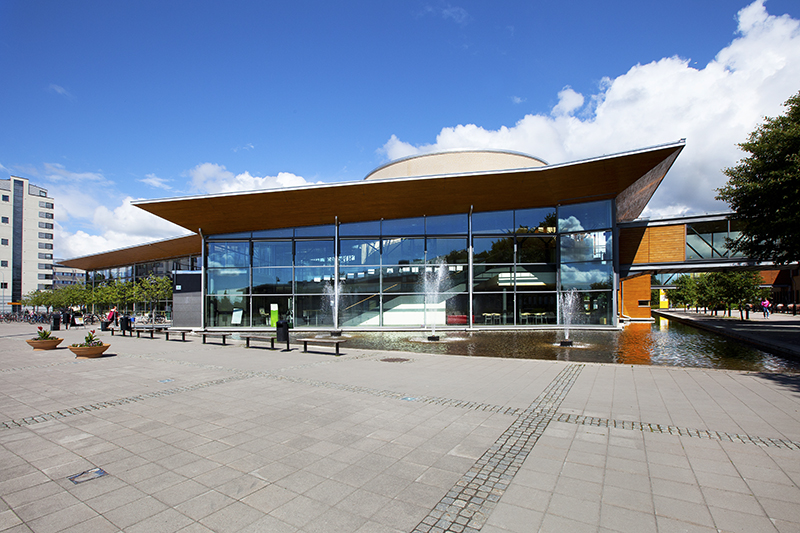
In the lower part of the building facing the square is the Main Entrance. Here you will find the library, which extends over three floors. In other areas of the Library House you will find the university's auditorium with an entrance on the 2nd floor, and Café Selma on the entrance floor.
Contact information
If you have questions about the house, or have found errors or deficiencies that need to be addressed, please contact us via customer service or submit an error report via this website.
Elevators
The buildings are equipped with several passenger elevators. - It is prohibited to transport bicycles in all elevators. - In the event of a fire, the elevators must not be used. - In the event of a power outage, the elevators automatically go down to the nearest floor. - If an elevator stops between floors, the emergency signal button must be held down for at least 15 seconds. Outside an alarmed elevator, an alarm signal sounds and a call is automatically connected to the elevator emergency service, which is available 24 hours a day.
Entry
The main entrance is unlocked during office hours 8 am - 8 pm. At other times, entry is permitted with your Kau card. Signs and notices Always contact the landlord if you wish to put up signs, or for events outside the premises.
Akademiska Hus has ambitious climate and energy work and strives to reach net zero greenhouse gas emissions by 2040, which is reflected in everything we do in our properties. You can read more about our climate goal here: Our path to net zero – 2040 | Akademiska Hus
Heating and cooling
The building has a water-based heating system with radiators and is equipped with smart sensors that are designed to ensure an optimal indoor climate with as low energy use as possible.
Sun protection
Automatic solar shading is an important part of the building's climate envelope and contributes to energy efficiency, comfort and architectural expression. The purpose of solar shading is to reduce unwanted solar radiation and heat load during warm periods, while preserving daylight and views.
Water
To save water, we have installed low-flush toilets and faucets that reduce water flow. We have also installed shower heads and mixers that save water without compromising comfort.
For you as a tenant
We want to create sustainable and resource-efficient buildings and campuses as possible – and we can only do that together. Through small, simple measures in everyday life, we can reduce energy use and contribute to both a lower climate impact and a better indoor environment.
How you can contribute ·
- Turn off lights when you leave a room, and use natural daylight whenever possible.
- Turn off equipment completely when not in use – computers, monitors, printers, etc.
- Keep windows closed when heating or cooling is on to maintain an even indoor climate.
- Avoid blocking vents – they are important for good airflow and energy-efficient ventilation.
- Use less water. Hot water requires a lot of energy. Report dripping taps and run the dishwasher full.
- Report faults in lighting, heating or ventilation so they can be fixed quickly.
Lighting
In public areas such as corridors and stairwells, lighting is controlled with presence sensors. Entrance lighting is time-controlled. Tenant areas (offices and labs) are lit manually via push buttons and turned off automatically. The lighting is energy-efficient and LED-based.
Temperature
A room can feel warm to some and cold to others. How we experience the temperature depends on several things, such as activity level and clothing. Our property technicians ensure that the systems are working and that the temperature and ventilation are set correctly, but each individual experiences the climate differently.
We always strive for the best possible indoor climate. We ask for your understanding that the systems sometimes need some time to adapt to weather changes. This delay is a natural part of how energy-efficient buildings work in a country with large temperature variations during certain seasons.
Ventilation
The ventilation is adapted to the number of people and equipment used in the rooms. The number of people the room is suitable for is stated in the rental agreement. The lab has demand-controlled ventilation that increases the airflow when the fume hood is opened. Closed fume hoods use less energy.
Extended operating time
After working hours, the ventilation is switched off to save energy. You can start it manually with a push button in corridors and copy rooms. The ventilation continues for a preset period of time.
Error reporting / adjustments to the indoor environment
If you experience problems with the indoor environment, please contact us via customer service or submit a fault report via the Akademiska Hus website.
Car parking
Parking spaces intended for vehicles with a handicap permit can be found close to the entrances.
Entrances and lifts
The entrances are accessible and all floors can be reached via lift.
Tactile walkways
A tactile walkway for people with impaired vision is available from the bus stop to the welcome center in the main entrance.
RWC and rest room
Toilets adapted for the disabled are available on each floor. In rest rooms and at the RWC there are security alarms with red push buttons labeled "emergency signal". Alarms are indicated locally by sound and a red flashing light outside each room. It is important that you who see and hear this alarm contact the person concerned who needs help. The security alarm is forwarded to reception during the day. Alarms are reset inside each room by pressing the reset button.
SCARED - WARN - ALARM - EXTINGUISH
• save yourself and others around you, but don't take too many risks yourself
• warn others who may be in danger
• alert the Emergency Services by calling 112
• put out the fire if possible
Automatic fire alarm
Evacuation alarms in case of fire are triggered via smoke detectors placed in escape routes, technical spaces and in spaces where many people gather. Triggered alarm, i.e. signal to evacuate, given via doorbell throughout the house.
Triggered alarms go to the emergency services. Limit the source of the fire by closing windows and doors.
You can manually trigger the evacuation alarm using push buttons in connection with the escape routes.
Fire cells
The building is divided into a number of fire cells to prevent fire and smoke from spreading.
Each fire cell is delimited by fire-rated walls and doors. In principle, all floors, stairwells, elevators, operating spaces and waste rooms are their own fire cells. Doors in fire cell boundaries can be magnetically suspended in the open position for transport and closed manually with a push button marked "fire door closer". When an evacuation alarm is triggered, the doors close automatically within the alarmed area.
Doors in fire compartment boundaries must absolutely not be blocked by wedges or the like!
Escape routes / Assembly point
See evacuation plans in corridors.
The stairwells form independent escape routes. Two stairwells can be reached from each workplace. The escape routes, which are marked with green, luminous escape signs, must never be blocked. The green signs are always lit and have a battery backup to illuminate even in the event of a power cut.
If the fire alarm is triggered, all personnel must leave the building, close all doors behind them and gather at the assembly point. The staff reports there to the evacuation recipient and leaves their name and group affiliation or equivalent. No one may depart from the assembly point until this is done.